

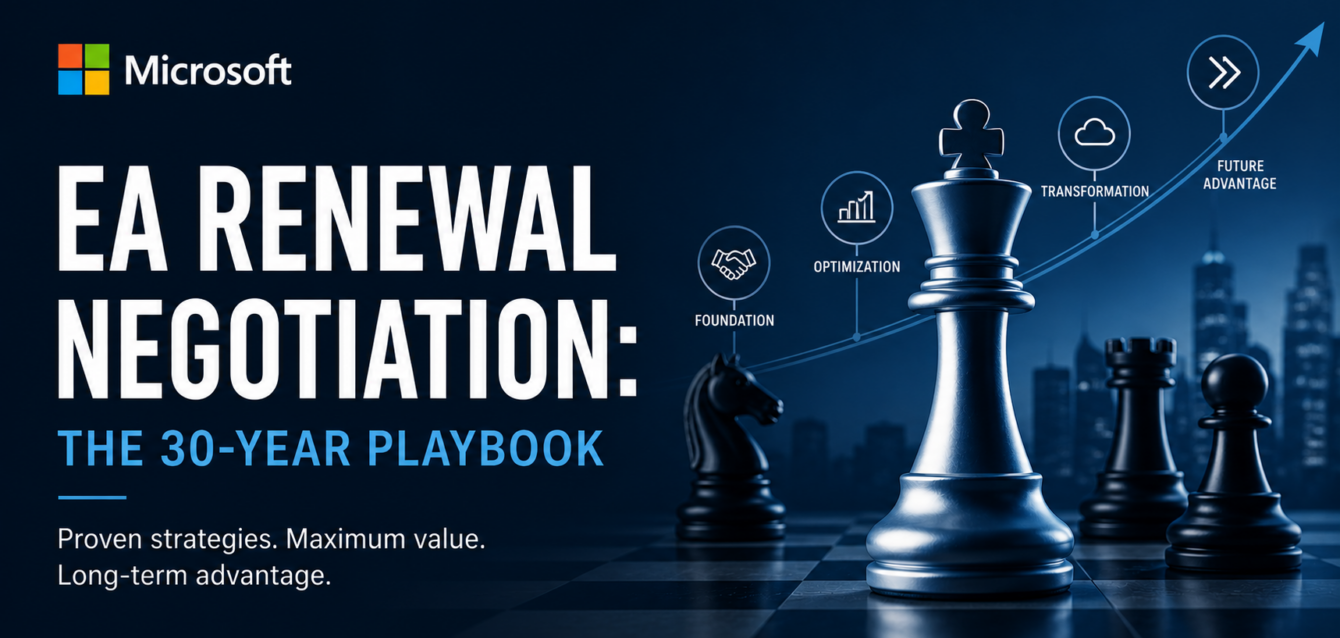
I spent 8 years inside Microsoft selling the Enterprise Agreement before I started helping clients negotiate against it. The Microsoft EA renewal negotiation playbook has not changed in 30 years. Every renewal walks into the same machine. Most clients do not see the machine.
Here is how it works. Microsoft builds a bundle and it gets put into a EA Renewal strategy. A weaker product gets buried inside it. The bundle locks the customer. The product rides the bundle to a billion dollars in revenue. The revenue funds R&D. R&D makes the product good enough. The dominant competitor dies. Then it repeats.
Office bundled Word, Excel, and PowerPoint, and killed Lotus 1-2-3, WordPerfect, and Harvard Graphics in one move. The EA bundled Office, Windows, and the BackOffice CAL. Exchange was weak. Notes was dominant. Microsoft forced Exchange into the bundle, took it to a billion in revenue, made it good enough, and killed Notes.
Then they bought SharePoint. The early product was thin. They pulled SQL out of the bundle, dropped SharePoint in, grew SQL as a standalone line item, and pushed SharePoint to a billion. Notes died a second time.
When EA renewals slowed, they moved Office to subscription and called it Office 365. It is a desktop application. Not a SaaS product. But once it sits inside a bundle as a subscription, the customer is locked in differently.
Then M365. Then E7. Same game. New SKU.
When revenue stalls between cycles, the metric changes. SQL Server moved from processor counting to core counting. More cores means more licenses means more revenue. Nothing in your environment changed. Your bill did.
That is the playbook. Now look at where E7 fits.
Why E7 Is the Same Move with a New Bundle
E7 is Copilot bundled onto E5 with two new products riding along. Both new products are version 1.
That matters. What is Microsoft’s track record with a v1 product?
Look at Bing. Look at Teams in 2017. Look at the original SharePoint. Each one launched weak, got bundled in to drive adoption, and only got to “good enough” after the bundle had already done the commercial work. E7 follows the same shape. The bundle does the selling. The v1 products ride along. By the time the renewal hits, the line item is locked.
Three shifts have changed the Microsoft EA renewal negotiation this cycle, and most procurement teams have are not of aware of this.
Microsoft does not have dominant E5 share to force E7 the way it forced every previous bundle. With Office, Exchange, SharePoint, and Office 365, Microsoft was either dominant going in or buying time inside a bundle to become dominant. E7 is launching into a base where E5 is still a minority SKU at most enterprises. The forcing function is weaker than it has ever been.
Real AI alternatives exist for the first time in 30 years. Large enterprises are already deploying OpenAI and Anthropic instead of Copilot, or alongside it. That is not a bluff in a renewal conversation. That is a working alternative with measurable adoption.
Discount benchmarking is still the wrong frame. I had a client last quarter with 10,000 E3 licenses. Real demand was 6,800. Procurement negotiated a 15% discount on the renewal and called it a win. The discount saved them $570,000 a year. The 3,200 inactive licenses were costing them $1.9 million annually. They paid $1.3 million more than they needed to. Called it a win.
The discount was the wrong battle. The bundle is the move. Recognizing the bundle as a move is the answer.
Microsoft EA renewal in front of you and no clear position on where you actually stand?
Take a look where you are at before Microsoft does.
What We’re Seeing in Microsoft EA Renewal Negotiations Right Now
E7 is showing up in proposals already, often before the client has decided whether E5 is right for them. Renewal proposals are landing 50 to 60 percent higher than the prior baseline with nothing in the customer’s environment changed. Microsoft eliminated the EA price levels last cycle, which means a former Level D customer no longer has a Level D anchor to negotiate from. Procurement teams chasing “best discount” are still chasing the wrong number. The structure of the deal moves more dollars than the discount line ever does.
The data confidence gap is the real story. Most organizations enter a Microsoft EA renewal with 50 to 60 percent confidence in their own data. Microsoft enters with 95 percent confidence in the data they are using to build your proposal. Note that I said the data they are using. Not your data. That gap is the whole game.
We pulled $2.5 million out of a recent EA proposal that started at $7.5 million and closed at $5 million. $2 million came from optimization. $500,000 came from SQL Server over-licensing. $1.5 million came from M365 right-sizing. The numbers were sitting in the client’s environment the whole time. They had the data. They did not know what to do with it.
Five Questions to Ask Before Microsoft Asks Them First
If a Microsoft EA renewal is on your horizon, these are the questions worth answering before the renewal conversation starts.
- What is Microsoft’s track record with a v1 product, and how does that history apply to the new SKUs in your proposal?
- Have you priced the bundle line by line, or are you negotiating against the bundle as a single number?
- What is your real demand for Copilot, and have you tested OpenAI or Anthropic against it for your actual use cases?
- Do you know which licenses in your tenant are inactive, and what those inactive licenses are costing you each year?
- If Microsoft handed you a renewal proposal tomorrow, how long would it take your team to produce a complete, independent license position from your own data? [INTERNAL LINK: SAM Health Check Blueprint product page, add URL]
The clients who win at Microsoft EA renewal negotiation are not the ones who negotiate hardest. They are the ones who recognized the game before Microsoft sat down at the table.
Every bundle in the last 30 years was a move. E7 is the next move. Whether you see it as one is the only question that matters before the renewal hits the desk.